Process automation
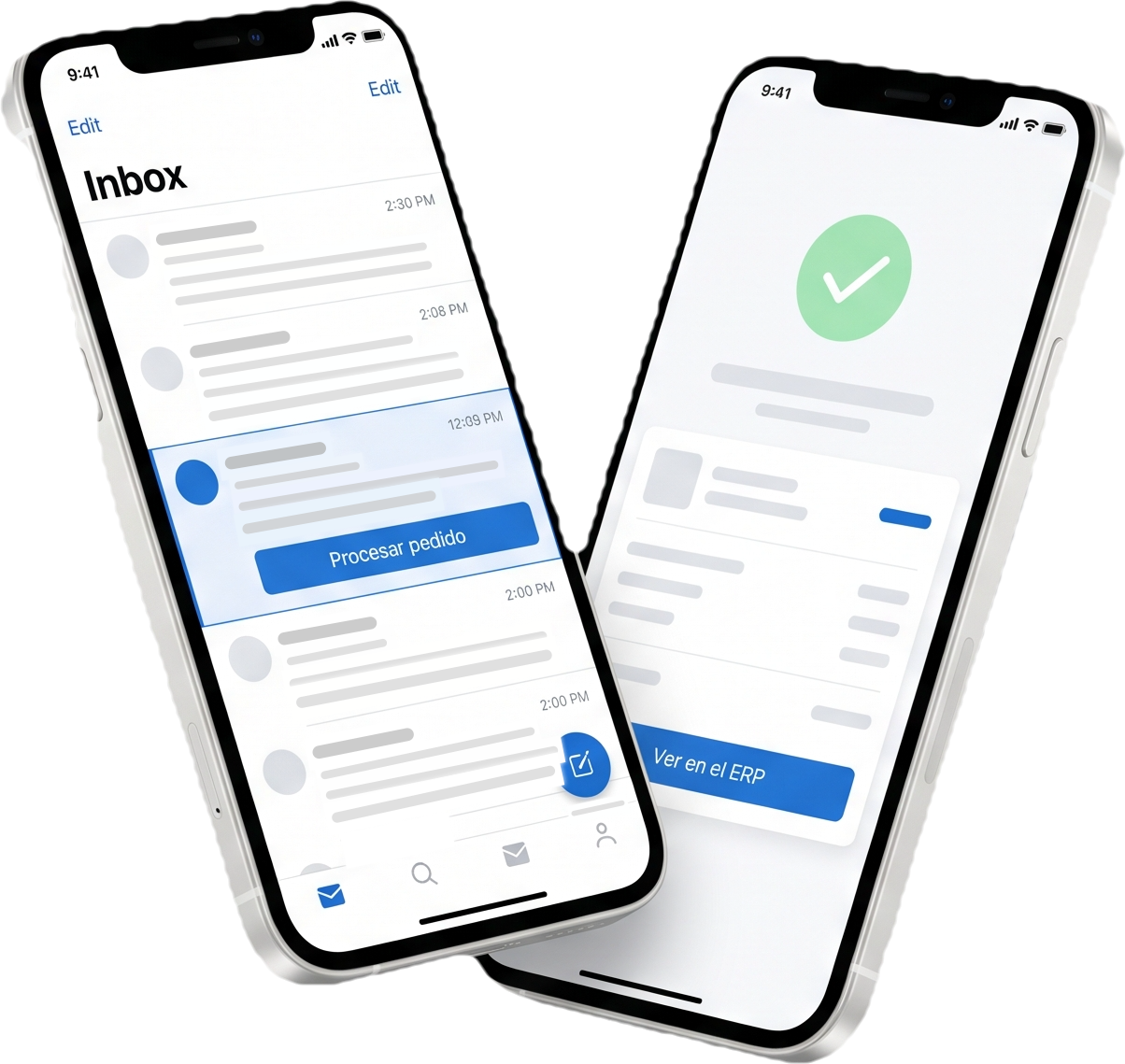
A process that’s done by hand today, such as entering emailed orders into your ERP, running on its own, with human review wherever it’s needed.
- Typical timeline
- 3 to 6 weeks
- Price
- Fixed price, agreed before we start
What it solves
Orders that arrive as PDFs and someone retypes into the ERP, delivery notes copied into a spreadsheet, reminders that depend on someone remembering. It’s repetitive, slow and error-prone work that ties up people who could be doing something else.
What’s included
- One process automated from end to end. For example: receive the order, read it, check it and enter it into the ERP.
- AI only where it adds value, such as reading documents that arrive in different formats.
- Checks against your own data: customer, item, price and stock.
- A review queue: anything that doesn’t add up isn’t entered, and is set aside for someone to review.
- Email alerts when something needs attention.
- A log of every operation, so you know what was done and when.
- Code in your repository, accounts in your name and handover documentation.
How it works
Intro call
You show me the process as it’s done today, with real examples.
Fixed proposal
Scope, price and delivery date in writing, with a list of what the process will and won’t do.
Build and testing
Weekly written updates. Before going live, we test it with real documents, running in parallel with the manual work.
Go-live
We leave it up and running, with documentation and 30 days of support to handle any cases that come up.
Frequently asked questions
What if the AI gets something wrong?
That’s what the checks and the review queue are for. Every piece of data is checked against your ERP, and anything that doesn’t add up isn’t entered until someone reviews it.
Do I need to change my ERP or my software?
No. The process works with what you already use. Before proposing anything, I check whether your ERP already has a feature that solves it.
Do you use AI?
Yes, where it adds value: for example, to read orders or invoices that arrive in different formats, and to deliver faster and for less. The AI never enters anything that doesn’t add up without someone reviewing it first.
What happens after delivery?
You get 30 days of support to fix bugs and fine-tune details. After that there’s an optional monthly maintenance plan. If you’d rather not, you keep everything documented so whoever you choose can maintain it.
What if I need changes?
The scope is fixed in writing in the proposal. If you need something different along the way, I tell you what it means for price and timeline before doing anything, and you decide.
Who owns the code?
You do. It lives in your company’s repository, and the accounts for the services it uses (hosting, domain, APIs) are in your name. No lock-in: you can keep working with me, with someone else or with your own team.
Other services

Process audit
Before investing in a project, find out what’s actually worth automating. You get a plan with three prioritized proposals, each with scope, timeline and price.

Custom dashboard
The numbers you check every week, in a web dashboard that updates itself from your spreadsheets, your ERP or other sources.
Is this what you need?
Tell me about it in a 20-minute call, and I’ll tell you whether it makes sense and how I’d approach it.